Are you frustrated or dissatisfied by an
underperforming strategic partnership?
If that question rings true for your company, you are not alone. Most companies struggle with underperforming partnerships. Many partnerships fail to live up to their promise, wasting time and money.
Your company does not have to settle for underperforming partnerships. Your company can structure deals that help both companies outperform the competition, giving you both a strategic advantage in the market place, while also increasing profitably.
The key to success? Getting to We, not just getting to yes. It’s all about mutual success. Partnerships that exceed financial and performance expectations are premised on What’s In It For We (WIIFWe)™ not What’s In It For Me. Both companies share one vision for success and each executes on that vision. These partnerships are Vested™.
Vested partnerships are very successful. Buy-side companies have seen 10-25% cost savings, while suppliers have earned as much as 10-30% margins. What buying companies save more than pays suppliers a fair profit. Sound too good to be true? Download our case studies now.
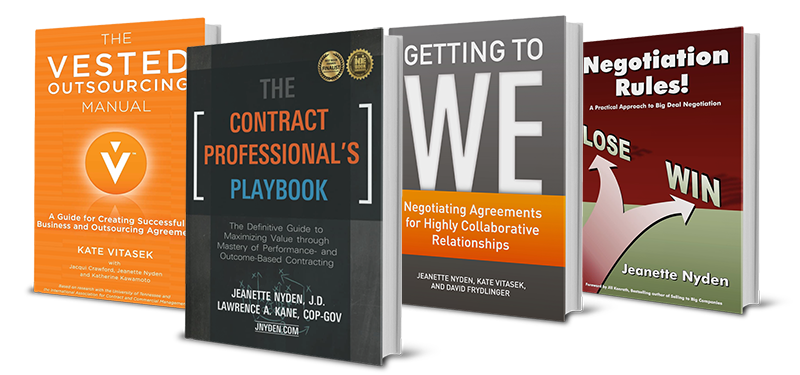
Not only have I’ve worked with companies to help them re-structure their agreements to drive performance and profitability, I co-wrote The Vested Outsourcing Manual: A Guide for Creating Successful Business and Outsourcing Agreements. I am also the co-author of the forthcoming Getting To We: A New Negotiation Paradigm for the 21st Century. My work is based the principles of Vested Outsourcing™, which is steeped in research conducted by Kate Vitasek, Mike Ledyard and Dr. Karl Manrodt through the University of Tennessee. In 2009 I wrote Negotiation Rules! A Practical Approach to Big Deal Negotiations.
Would you like to know more?
Who I Work With
I work with companies to help them structure and negotiate high performing B2B partnerships. Companies I’ve worked with span a variety of industries including facilities management, aerospace and high tech. All of my clients have one thing in common: a desire to transform underperforming B2B partnerships with professional guidance. They also wanted mutual success. For my clients, it was no longer good enough to have success at the other company’s expense.
My clients are often frustrated and dissatisfied by underperforming partnerships. They don’t understand what went wrong. Both companies signed the partnership agreement with high hopes of financial success and improved performance. But somehow, the relationship has failed to deliver on its promise. What they signed up for is not happening.
My clients face some typical challenges.
• “Value Leakage” or “Deal Erosion” as evidenced by shrinking margins and increased costs coupled with increasing sense of frustration with their partner. Despite high hopes when the contract was signed, neither company is meeting margin goals, impacting bottom line profitability.
• Companies inadvertently contract for performance breakdowns, rather than enhanced performance. Companies try to cut corners by using last year’s SLAs or SOWs. Without establishing a current baseline of actual business need though, buyers contract for services that no longer provide value to the end user, creating tension between the end user and the supplier.
• Companies dismiss profitable partnerships as “one of a kind situations that are driven by personalities” rather creating a structure for success. Opportunities are missed to mine working relationships for intelligence, and once the driving personality moves off of the account, gains are often lessened if not lost all together.
• Poor or no governance structures, or governance structures that no one pays attention to cause small issues to balloon into real problems in no time whatsoever. Buyer’s expect performance but can abdicate constructive management by allowing their people to act like junk yard dogs towards a strategic partner. Service providers, on the other hand, take a passive aggressive approach, being overly polite in person while blaming the customer in private.
• Poor peer-to-peer (“2 in a box”) relationships causing a strain on productivity. When things don’t go as planned, people at both companies blame each another, escalating tension between the two companies and decreasing productivity. Furthermore, people don’t integrate a diverse set of skills, competencies and expectations (of themselves and each other), compounding the misalignment.
No matter which of these situations your company finds itself in, I can help.
I work for a solution, not one party’s limited point of view. As an impartial expert, I have a bird’s-eye view of both the problem and potential solutions. I advocate for the partnership and what that partnership can do to improve the market. Working with me, both the buying company and the supplier Get to We. They learn to work with diverging points of view in order to solve complex business problems.
What my clients really want is more value and better outcomes for their end users and customers. Strategic relationships that fail to meet financial and performance expectations are a drag on both companies’ bottom line. What’s more, it’s not just the partners who suffer; the end user of the service (or consumer) feels the effects too.
Your company does not have to settle for underperforming partnerships. Your company can structure deals that outperform the competition giving your company a strategic advantage in the market place and increase your company’s profitably. Other companies are experiencing real financial results simply by structuring and negotiating high performing deals. (Would you like to read one of our case studies?
I’ve found that successful engagements have several things in common. Companies, both buy-side and supply-side:
• Acknowledge that the partnership is not meeting expectations or goals, and that they might be contributing to the problem. It’s just not the other guy’s fault. Typically, both companies contribute to the problem.
• Educate themselves about industry best practices, and are willing to put those practices into place. Talk is cheap. At the end of the day, the company must know what to do differently and have the desire to do better.
• Improve their company’s profitability by creating value rather than extracting value. A cost reduction glide path is but only one way to improve profitability. In a consolidated market, however, cost cutting will prove increasing elusive, while creating value will give your company a strategic advantage.
• Work more collaboratively with their partners. Collaboration is more than a buzz word, or a group hug. It means leveraging the best out of the partnership in order to enhance the end user’s (or customer’s) experience.
• Change negative mindsets that prevent individuals from doing things differently. Sometimes people just don’t want to change. They justify their behavior and dig their heels in. But, if you’re striving for better performance, there is no room for negativity.
• Welcome guidance and a fresh approach to structuring and negotiating high performing partnerships.
If you would like to better understand the drivers behind your underperforming partnership, and get some guidance to improve that relationship, email me at info@jnyden.com to schedule a complementary strategy session. During the session, we will discuss your current challenges, goals or desires, obstacles preventing the partnership from achieving its goals, and suggestions for moving forward.
How I work with Clients
I believe in Getting to We, not just getting to yes. I’ve been an attorney for 18 years. For the first 10 years, I worked diligently as a litigator to help my clients get to yes. After attending mediation training in 2002, I had an epiphany. Objectivity is powerful. I was free to work for a solution, not one party’s limited point of view.
Working as an impartial facilitator gives me a bird’s-eye view of both the problem and potential solutions. I still advocate—that will never change—but for the partnership and what it can do to improve the market. Working with me, both the buying company and the supplier Get to We. They learn to work with diverging points of view in order to solve complex business problems.
Why do some companies have wildly successful partnerships, while so many others struggle with underperforming relationships? This question drove my colleague and co-author Kate Vitasek to spend years researching high performing strategic partnerships through the University of Tennessee. Kate and the team coined the partnership approach Vested Outsourcing™.
What We’ve Found:
• Both companies see improved margins, reduced costs and improved profitability. The deal more than pays for itself. For example, buying companies report cost reductions totaling between 10-25% over the course of the agreement, while service providers on that same deal will report margins of between 10%-30%. Companies never complain about “Value Leakage” or “Deal Erosion” after their deal has gone “Vested”.
• Companies contract for innovation and peak performance. With some rigor to identify and baseline the real business need (not the perceived need from last contract’s SLAs), companies get what they need and suppliers perform to expectations. All the tension surrounding performance goes away as both companies seek to make the end user (or consumer) happy.
• Companies create a repeatable process and a strong structure that is deployed across the organization to many different kinds of strategic partnerships. Both companies continue to refine the partnership, which only adds to profitability, efficiencies, and innovations that create market advantages for both companies. Those refinements are then used as best practices in other partnerships.
• Flexible and workable governance structures that provide not just oversight, but real-time insight. Small issues are addressed quickly and efficiently, leaving time for management to look out into the future to anticipate changes in the market. No longer a reactionary relationship, both companies become proactive, giving them both a strategic advantage.
• Peer-to-peer (“2 in a box”) relationships are productive, effective and respectful. Companies come to depend on their partners for intelligence and advice to solve complex business problems. Companies are aligned up, down and across the organizations.
High performing partnerships use a process and a structure for success. It is not a mystery or a onetime event driven by the force of one personality.
My Approach Is Unique
As a Vested Outsourcing Certified Deal Architect, I am objective and independent. I am not a hired gun for any single company taking my fees from the savings I extract from the negotiation process. Rather, I advocate for the partnership. From a place of objectivity, I see what the parties cannot, while avoiding being blinded by my own self-interest to increase the price point variance. Both companies agree to hire me and work with me. At the end of the day, both companies trust that I will be fair to them both.
I use a variety of tested tools in my work, ranging from proven assessments, step-by-step processes, to facilitated meetings that get work done.
If you would like to better understand the drivers behind your underperforming partnership, and get some guidance to improve that relationship, email me at info@jnyden.com to schedule a complementary strategy session. During the session, we will discuss your current challenges, goals or desires, obstacles preventing the partnership from achieving its goals, and suggestions for moving forward.
|